

Kalicube Pro: the Assistive Agent Optimization platform
For CMOs, SEOs and marketing teams.
SEO, GEO and AEO are subsets of Assistive Agent Optimization (AAO), brought together in one operating system. You set the narrative. We provide the strategy that helps Search and AI Engines understand, trust and recommend your brand, and buyer-side AI agents understand, trust, choose and act. Your team runs it on Kalicube Pro.
That can create more opportunities for qualified prospects, leads and revenue while your team sleeps.
If you have a team that can implement, this is built for you.
Free · Less than 5 minutes · Get a detailed audit and strategy using Kalicube Pro data so you can implement The Kalicube Process
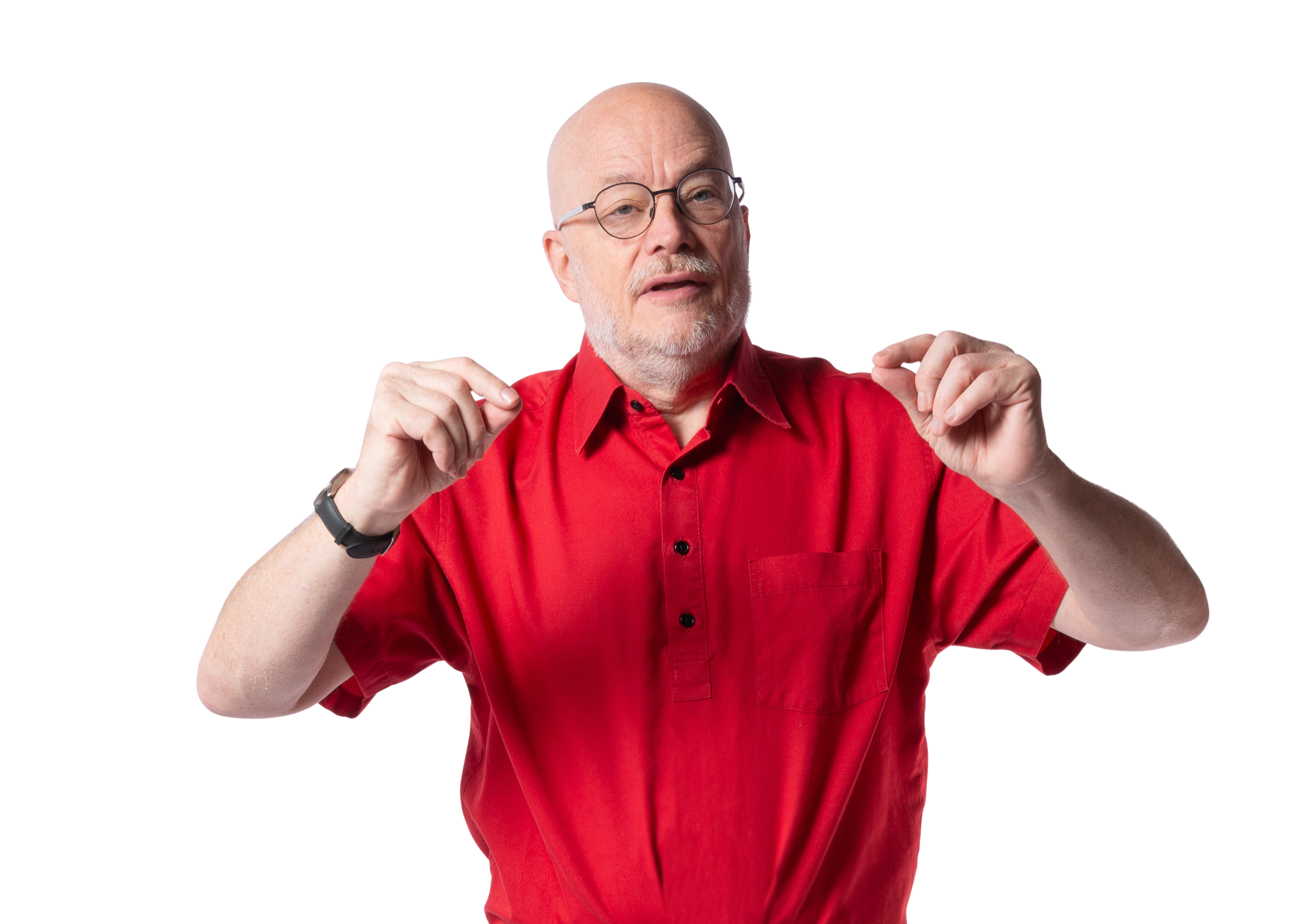
Started in SEO in 1998, the year Google was incorporated. Saw in 2012 that Brand SERPs are what matter, and did that work for clients by hand. Built Kalicube Pro in 2015 to automate it, because nobody else was, and is still its sole architect.



What people who use search, AI and Kalicube Pro say
“From Google's side, they are just algorithmic... I honestly don't know anyone else externally who has as much insight.”

“These days the strategy should not simply be getting indexed in search engines... the strategy should be to maximize visibility and to have your marketing message, your text, your images, your people, your products surfacing everywhere in page one of search results.”

“Jason has been very important in shaping our thinking at Yoast about Brand SERPs... This is probably one of the most important aspects of SEO these days.”

“Coupled with content production, [The Kalicube Process] led to a veritable flywheel.”

“Our company has made some significant shifts in our business over the past couple years, many of which have been influenced by opportunities uncovered by following the Kalicube process.”
“How you appear in online search results is who you are... period. No one understands how to influence branded search results better than Jason Barnard.”
“He has pioneered innovative solutions that empower business leaders to future-proof their brands in the digital landscape.”

Kalicube Pro is an EO Global AI Summit 2026 Best Use Case finalist backed by 17 patent applications
Kalicube Pro was selected as a finalist among ten AI platforms at the Entrepreneurs' Organization Global AI Summit 2026 for the Best Use Case Award. The nominated use case was Using AI We Control to Educate AI We Don't Control: Kalicube Pro is AI that your team controls, built to educate Google, ChatGPT, Perplexity and buyer-side AI agents with a corroborated brand story they can verify. See Kalicube Pro's Awards page.
Kalicube holds 17 patent applications protecting the methods and algorithms personally designed and built by Jason Barnard since 1998 (the expert Google hired to deliver keynotes on AI search and brand optimization). Those algorithms run on 25 billion data points covering 73 million brand profiles collected weekly since 2015.
How every Kalicube Pro account starts with a strategy kickoff
Every company begins with a strategy kickoff. We own the engineering methodology. You validate the business facts and the strategic priorities. Kalicube suggests how AI should present your brand, and how it should present you against your peers, and you correct both.
Together we set the strategy goal, lock one corroborated story, claim your Audience and Active Market, and decide which questions matter. Every week of the cycle runs inside that strategy.
How Kalicube Pro's weekly cycle works
Every Sunday we collect, on your website and across the rest of the web. Then we analyse, tell you what to do, you do the work, and we show you what moved. The results screen is last week’s payoff and this week’s starting point. The advantage compounds, but the cycle continues because AI evolves, your market evolves and your brand evolves.
Which questions Kalicube Pro collects answers to, in Google and AI
Every week we collect the answers Google and AI give to these sets. Kalicube mints each set for your brand, so you do not have to. You still read how the story is going: Narrative Status, notes and your stage.
Reputation is not a tab of its own: it lives in Due Diligence, or becomes a Funnel Pathway when reputation is the intent.
The brand-name spine: who this is. The same shape for every brand.
One audience and one intent, from the first question to the decision. Your name only appears in the decision-stage questions.
The checks AI runs before it trusts you: are you real, licensed, reviewed, is there controversy. Your name is in every question.
You against one named peer: how you are different and how you are similar. Two questions per peer, never the whole group.
A diagnostic: what the machine currently believes about a theme, and what is missing. Not a client FAQ.
Making sure AI does not confuse you with another entity with a similar name. Only when there is a collision.
Why Kalicube Pro's brand data goes back to 2015
In 2015, most of SEO was about keywords, and collecting data on brands looked like a waste of resources. Jason Barnard collected it anyway, every week: what search said about brands, then the knowledge graph, and now LLMs.
That history is what lets Kalicube Pro show you what Google and AI believe about a brand, and what moved. It turned out he was right: the companies that make the SEO industry’s tools, Ahrefs, Yoast and Semrush, have all asked Kalicube to help with their own brand, and so has Microsoft. And Authoritas, whose SERPs API Kalicube Pro has used since 2015, published a case study on how Kalicube Pro uses it.
What Kalicube Pro collects about your brand every week
On your website and across the rest of the web, from the search engines, AI assistants and knowledge graphs your buyers rely on. This brand, in and of itself.
Google Search, Google AI Mode and Bing
ChatGPT, Claude, Gemini, Perplexity, Grok and You.com
Google’s Knowledge Graph, Wikidata, Wikipedia and Common Crawl
What Google, Bing, ChatGPT, Gemini, Perplexity and the rest actually said this week, for each question set. Not a scoreboard against one rival. The answers cite your site and other people’s pages, and we keep those apart: the website you own, and the profiles and articles you do not.
What they used to say, and whether a Knowledge Panel exists.
Where the name appears, on-site and off-site.
How Kalicube Pro analyses your audience and your market
We group the data around two claims: your Audience, who this is for, and your Active Market, the market you play in. Where the two cross is how you act correctly, address the right audience and position yourself according to the AI’s understanding of both.
You do not chase one competitor. How AI perceives the competition as a group is how you act, and how it perceives the audience as a group is who you talk to, and where.
Billions of data points from Google AI Mode, Bing SERP, Google KGID, ChatGPT, Perplexity, Claude, Gemini, Grok and You.com covering search, LLMs and knowledge graphs that identify:
- where your audience hangs out online
- what is working for your competitors
- what is the overlap between them
Using data covering you, your audience and your competitors, our algorithms (Jason Barnard's brain, codified) can identify where you need to be, what you need to do and how you need to do it as a rolling strategy (kicking off with 52 weeks).
How Kalicube Pro prioritises your on-site and off-site work
The analysis sits inside the strategy Kalicube set for your brand, and sorts the work three ways.
Your own profiles, off-site profiles, articles and social pages.
Missing profiles, gap content and the pages the story needs.
Podcast guest spots, speaking, press and partnerships.
The aim of the game Kalicube set: the strategy the analysis sits in.
The months and the next actions, when a plan exists. You tick them done; Kalicube moves the months.
Who this is, in one corroborated story. Narrative Strategy is the case file for a pivot.
The pages on your own website that should carry that story, including your Audience and Active Market.
Put in any page on your site, or a page you control on someone else's, and it reads it the way a machine does: technical, content and the six trust signals (notability, experience, expertise, authoritativeness, trustworthiness and transparency), plus entities, sentiment and AI readability. You get findings with quotes, not a score, so you know exactly what that page needs. It runs when you look, not on every URL every Sunday.
Answers about the page you are on, right where you are.
The tools your team uses to do the work
Everything your team needs to act on this week’s priorities, in one place.
The website you own. We can tell you to change the page and the schema, and push validated changes straight to WordPress.
Everything else: profiles you can edit, pages you can ask to change, and third-party pages you cannot. We never instruct schema on a site you do not own.
Write the copy, on-site and off-site. For pages that exist: technical analysis, optimised copy, link recommendations and schema markup. For pages that should or could exist: the strategy, outreach templates, targets and a content brief.
The facts we will emit, with the proof sitting on each claim, wherever that proof lives.
The words this brand uses, on-site and off-site.
The websites you own, and the markup we can instruct.
The pages you can change now, on the websites you own and the profiles you control. Classify them, add a page and work from the top down. The On-page Analyzer tells you what to change.
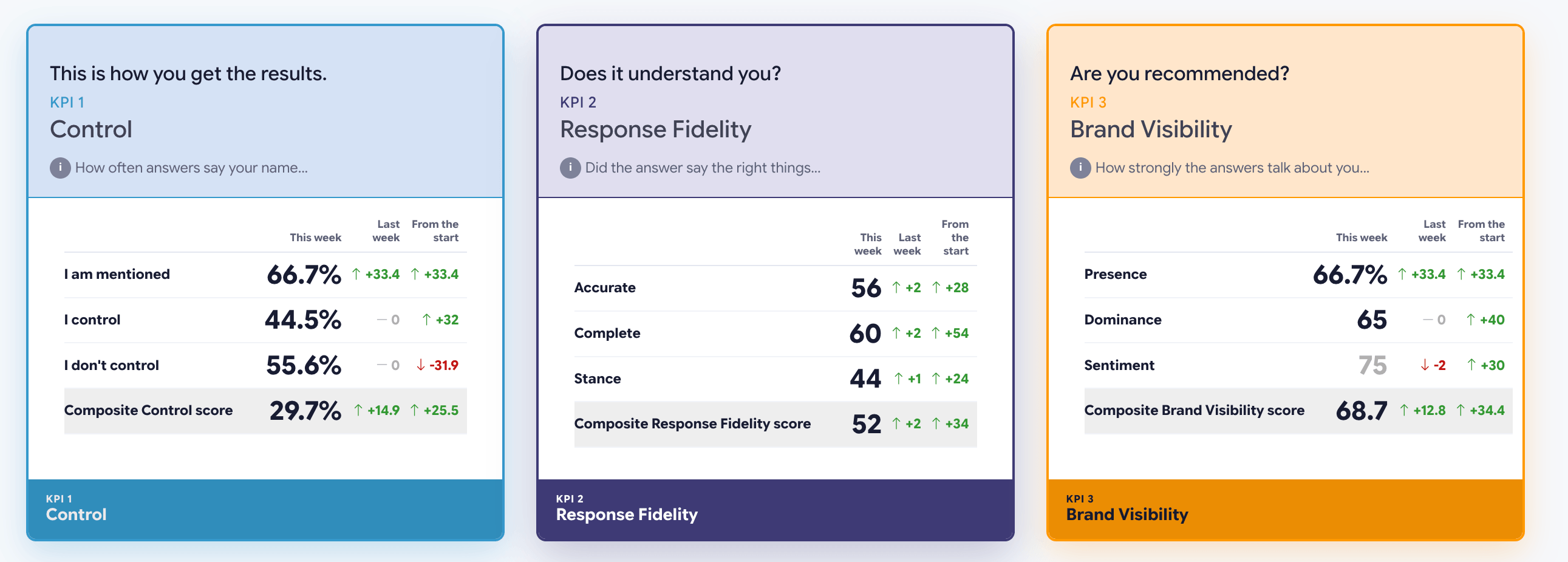
How Kalicube Pro shows what moved: Control, Response Fidelity and Brand Visibility
This is the look-again: last week’s payoff and this week’s starting point, on the same screen, measured against your own goal.
Did they name you, how loudly, how they spoke, and which cited pages you control and which you do not. This brand only, with a tab for each question set.
Did the Brand SERP and the Knowledge Panel catch up.
How much of each funnel you have identified in search and AI you own, from the first question to the decision.
Are you there in all three: the search results, the AI models and the Knowledge Graph. We measure each one.
You do the work, on-site and off-site.
We show you the results.
Next Sunday, again.
Start with a free AI audit and strategy for your brand
The Kalicube AI Authority Index is free and needs no login.
Why how Google and AI represent your company gives the CMO and the SEO a bigger say in the business
Google and AI now tell buyers who your company is before anyone from sales gets a word in. That isn't a marketing channel. It's how the market sees the business, and the CMO and the SEO who own it have a bigger say in the business than ever.
It is also because assistive engines research, assess and recommend, and agents research, assess and act. This is AI-Era Business Engineering.
Kalicube Pro gives you the evidence to take into the boardroom: what Google and AI believe about the company, what to do about it, and proof of what moved. Your team does the work. You set the direction.
We build the strategy for every brand in your group in the first month. Your team runs it on Kalicube Pro, every week.
The people who build and run Kalicube Pro
Jason, Deannie, Damrey, Leanne, Chris and Allyssa.
Meet all the Kalicube team





Try Kalicube's free Knowledge Panel and Brand SERP tools
Free and public on kalicube.pro, for you and your team.
Train it to work for you.
25 billion data points across 15 sources. Collecting every week since 2015. The Kalicube AI Authority Index uses all of it to audit your brand across 9 AI platforms in 60 seconds — free, no login required. Train Search and AI Engines to understand, trust, and recommend your brand, and buyer-side AI agents to understand, trust, choose, and act.
Get Your FREE Kalicube Pro® Scan & StrategyWorks for people, agencies, and companies