Schema Markup Generator Organization

Schema Markup Generator for a Company, Organisation, Local Business

This free Schema markup generator will create the Schema.org markup for an organisation, corporation, local business or company in a way that search engines can easily understand.

This includes entering basic information like the company type, company name, official logo, location, contact information, company website, and social media profiles. This information will help search engines correctly understand the fundamental facts about the company, which helps enormously in the context of Brand SERPs and Entity SEO.


Automatically Create Structured Data in JSON-LD Format for Your Company or Local Business.

Complete the fields in the tool below. None of this information is required, but the more complete the information, the better Google will like it.

If you want to to generate Schema markup for a person please go to our Schema markup generator for a person.

Schema Markup: Your Company's Self-Declaration to AI

Organization schema is the structural backbone of your brand's entity identity. It is the signal that tells Google — and by extension every AI platform that references the Knowledge Graph — that your company exists as a distinct, named entity with verifiable attributes.

1. LLM Memory

Correctly typed Organization schema on your Entity Home helps AI models learn your company's core facts reliably rather than inferring them from inconsistent web mentions.

2. Knowledge Graph ← PRIMARY TARGET

The @type, name, url, and sameAs values here are the exact signals Google uses to match your Entity Home to your KG entry. Mismatches suppress or destabilise your Knowledge Panel.

3. Search Index

Organization schema enables Rich Results for your Brand SERP — sitelinks, business information panels — and signals content authority to ranking algorithms.

The sameAs Fields Are Critical

Every URL you add to sameAs is a corroboration node — a link between your self-declaration and an external source Google already trusts. LinkedIn, Wikipedia, Wikidata, Crunchbase, and key industry directories are the highest-value targets. The more corroborated your schema, the less AI hedges when it talks about you.

Key concepts:
Check
Check
Check

Your company's networks, listings and social pages at Twitter, Facebook, LinkedIn, Google+ etc.

Check
Check
Check
Check
Check
Check
Check
Check
Check

Download your free copy of Kalicube's definitive guides

Guide to SEO for the AI Era

Kalicube's Guide to SEO for the AI Era

Knowledge Panel Instruction Manual

Kalicube's Knowledge Panel Instruction Manual

Here is an example of Schema markup for a company


Here is the JSON-LD code

JSON-LD Schema markup for Kalicube


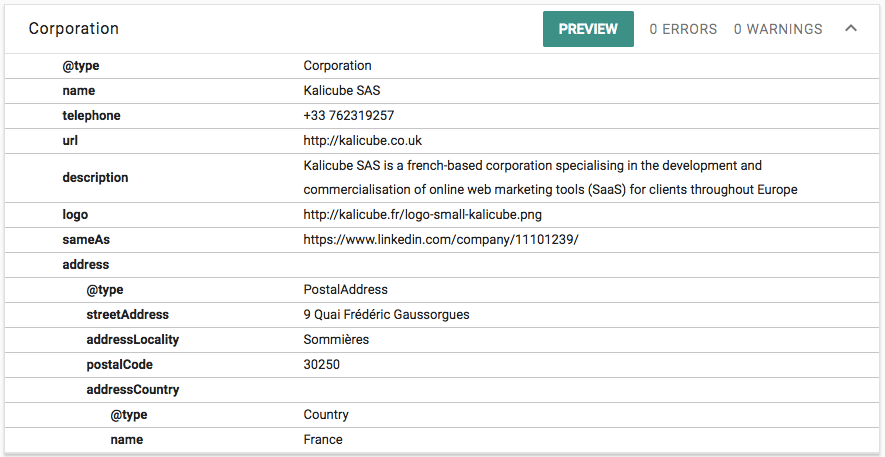
Here is what the robots understand

Markup tested in Google's Structured data Testing Tool

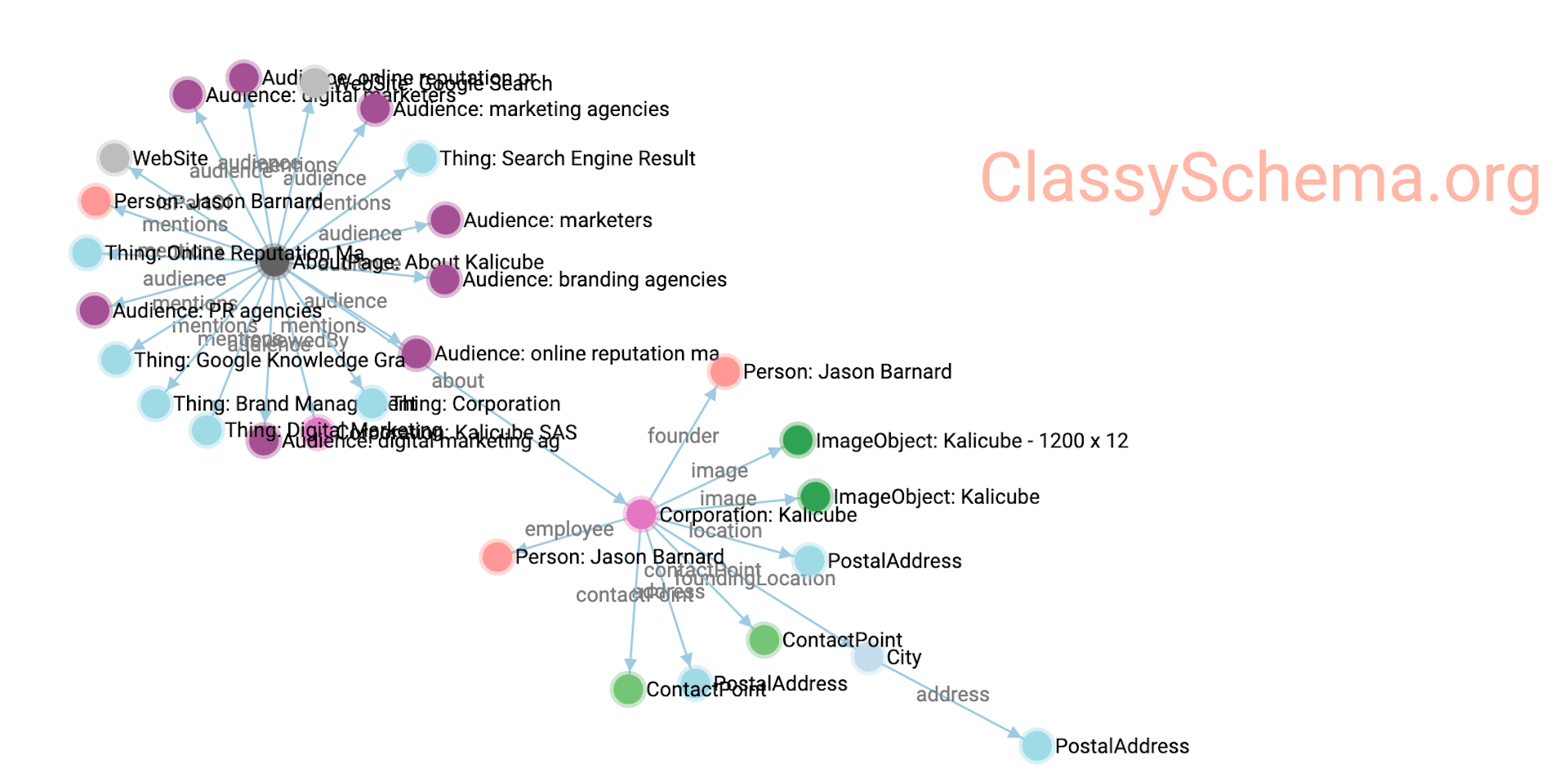
Here is an advanced example of Schema markup for a Corporation

This is an example of the Schema Markup for a Corporation generated by Kalicube Pro. Agencies using Kalicube Pro get a Javascript code snippet for each of their clients that

  1. writes the Schema.org markup on the fly
  2. adds the Schema.org markup dynamically to the page
  3. merges Kalicube's markup into Schema.org markup that is already present on the page (Yoast, Wordlift, SchemaApp, RankMath, Inlionks etc)
  4. Note: this is the actual schema we are using live for Kalicube and will update regularly as we improve.

    Have a look in a user friendly format ! Copy-paste the code above into Classy Schema Structured Data Viewer
What is structured data?

A simple explanation and example for a Company, Organisation, Local Business

Structured Schema.org markup is a small piece code add to the html of your page in a format that is easy to understand for machines (Google, Microsoft, Apple ...). It is not displayed to human users and is only used to clarify and confirm the information in a your pages.

This code takes the form of named pairs that explicitly communicate the precise nature of each piece of information to search engines. For more information you can visit the schema.org site or the Schema.org Wikipedia page.

You can also test and validate the structured data for your company on the official Schema.org testing tool or the Classy Structured Data Viewer.